
The Girl Who Learned to Become Necessary
Aug 15, 2026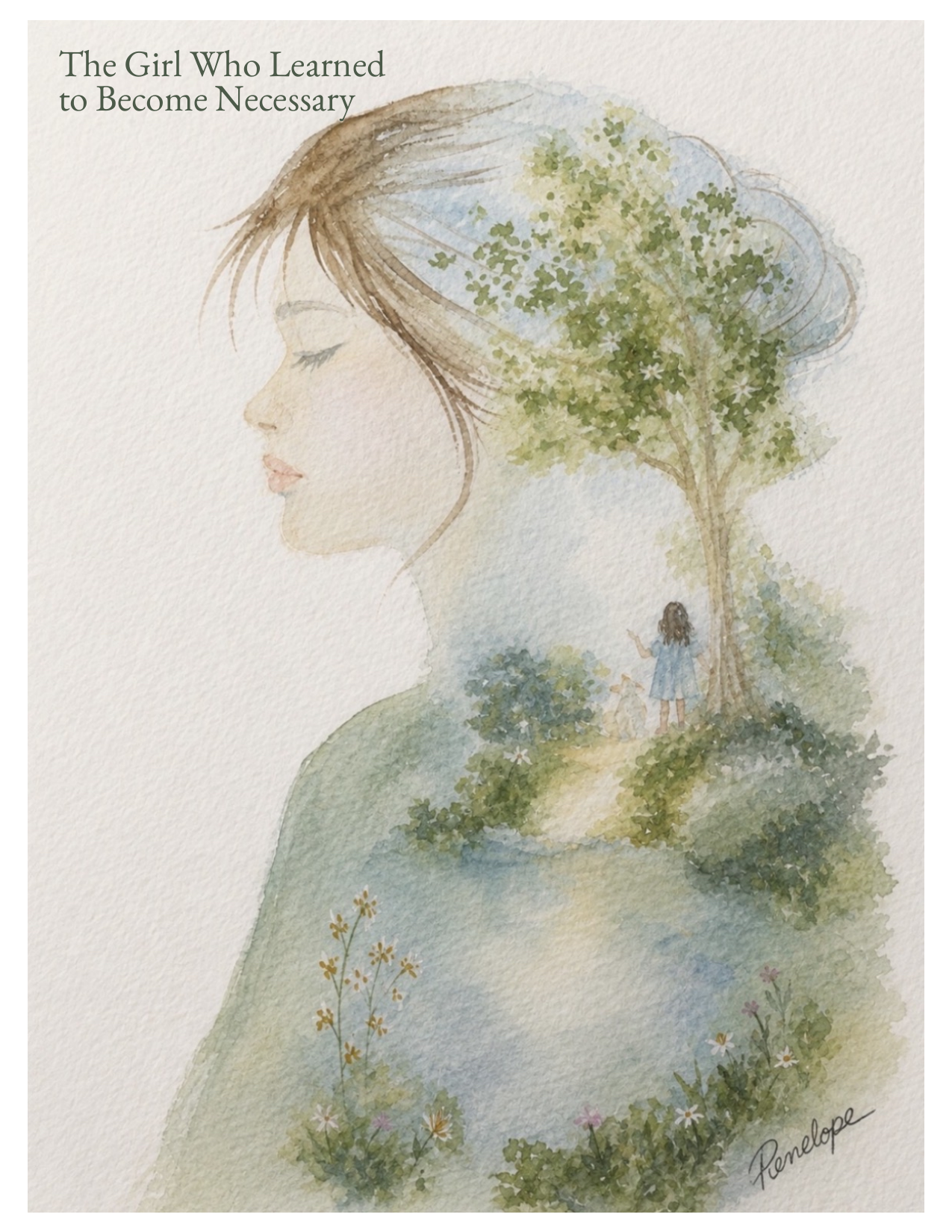
Prefer a beautifully formatted copy to keep in Your Library and return to later?
Download this chapter
The Girl Who Learned to Become Necessary
How a frightened child can grow into a woman who believes love must be earned through usefulness
Some girls are not raised inside safety. They are raised inside vigilance.
They learn to hear the change in a voice from another room. They know which footsteps mean trouble, whether a door has been closed gently or slammed, whether an adult has been drinking, whether anger is already in the house before anyone says a word.
They learn when to disappear, when to become agreeable, when to make themselves useful, when to stop needing so much.
A child should not have to become this observant. But when the adults around her are unpredictable, frightened, violent, absent, overwhelmed, addicted, unstable, or simply unable to protect her, paying attention can become a way of surviving.
She cannot control the adults. She cannot leave. She cannot build herself another home. So she works with whatever power is available to a child. She becomes easy to have around—helpful, responsible, watchful, needed.
And sometimes the child who cannot make the world safe discovers something that feels almost as good:
She can make herself useful inside an unsafe world.
That discovery can follow her for a very long time.
The child who stops being a child
There are homes where childhood is allowed to unfold. A child plays, makes noise, complains, asks for things, gets things wrong, becomes bored, and expects adults to handle problems she does not understand.
Then there are homes where childhood ends quietly. Nobody announces it. There is no moment when someone tells the girl, You are on your own now. She simply begins to understand that the adults cannot be depended upon in the ways she needs them to be.
Perhaps there is chaos. Perhaps there is fighting. Perhaps someone is sick. Perhaps money keeps disappearing. Perhaps fear sits at the dinner table. Perhaps she sees things no child should have to understand, and nobody ever asks what any of it is doing to her.
Somewhere inside all of that, a message takes hold:
You are going to have to manage more than a child should manage.
So she does.
Children can adapt to almost anything. She may become mature beyond her years. Adults may praise her for it.
1
What a responsible girl. So independent. So capable.
Nobody necessarily sees the sorrow underneath the compliment. She became capable because being helpless did not feel safe.
If everyone else is okay, maybe I will be okay
A child surrounded by instability can become deeply attuned to the well-being of everyone around her. Their mood affects hers.
If everyone is calm, perhaps she can relax. If nobody is fighting, perhaps she can sleep. If the troubled person is happy tonight, perhaps nothing bad will happen.
So she starts looking outward. What does everyone need? What can she do? What problem can she head off before it gets worse?
Much of what later looks like generosity may have begun here.
The child learns:
Other people being okay makes me safer.
Years pass. The house changes. The people change. The circumstances may be entirely different. But the old equation can remain.
Someone is struggling. Help.
Someone is disappointed. Repair it.
Someone needs money. Give.
Someone is frightened. Stay.
Someone has a problem. Solve it.
The woman may call this compassion, and much of it truly is. But somewhere underneath the compassion there may still be a frightened child trying to get the room settled.
The girl who learned not to need
When too much is happening in a family, a child can begin to feel that her own needs are inconvenient. She looks around and sees larger problems.
Why add hers?
So she becomes low-maintenance. She does not ask for much. She figures things out. She comforts herself. She learns to tolerate discomfort. She may even become proud of how little she requires.
This is different from simply becoming responsible too early. This is learning to leave herself off the list.
2
Years later, the woman who has learned not to need much can become extraordinarily available to everyone who does. Her needs stay quiet. Other people’s needs arrive with sirens.
The house can wait.
The body can wait.
The art can wait.
Sleep can wait.
Joy can wait.
She can wait.
She has been waiting for a very long time.
The first currency she ever had
A powerless child does not have much currency. She does not control the money. She does not decide who stays or leaves. She cannot make the adults become healthy.
But she may discover that usefulness has value. People approve when she helps. They soften toward her when she makes things easier. She is thanked when she anticipates what someone needs.
Perhaps she cannot make herself safe through authority, but she can make herself valuable through service. And usefulness begins to mean something.
I will help. I will carry it. I will make things easier. I will be the good one. I will not create another problem. I will become someone nobody wants to lose.
She does not simply learn to help. She begins to build her worth around being needed.
And that is where something painful can become tangled:
Being loved and being useful begin to feel like the same thing.
The child does not have to put this into words. Her life has already taught it to her.
The woman who can handle anything
Then the girl grows up. What was once adaptation can look a lot like strength.
She knows what to do in an emergency. She organizes chaos. She remembers details. She makes the phone calls nobody else wants to make. She finds resources. She gets things done.
People begin relying on her. They say:
Thank God you were here.
I knew you would know what to do.
3
I don’t know what I would have done without you.
Those words can reach something very old. Once again, usefulness brings belonging. Approval. Purpose.
She becomes the woman people call. And because she really is competent, there may be no obvious reason to question any of this for years.
Her strength is real. Her generosity is real.
The difficulty comes when strength is the only place from which she knows how to belong.
The eyes that never stopped scanning
Other people can notice a need and keep walking. She feels it.
The person without a coat. The animal that needs care. The family in trouble. The stranger crying. The friend overwhelmed.
A gap opens somewhere, and her mind begins working before she has decided whether the problem is hers. What could be done? Who could help? How much would it cost? Could she fix it herself?
Sometimes this is intuition. Sometimes compassion. And sometimes it is an old alertness wearing adult clothes.
The girl once scanned rooms for danger.
The woman scans the world for what is missing.
When responsibility becomes identity
After enough years, helping stops being only something she does. It becomes part of how she understands herself.
She is generous. Reliable. The strong one. The one who shows up. The one who does not walk away.
And the world often rewards this woman. People admire her. They praise her heart. Sometimes they depend on her more and more.
That can make the pattern hard to see. How could something be a problem when so much good comes from it?
That is the difficult part. A pattern can create beautiful things and still ask too much of the person carrying it. A woman can genuinely change lives while slowly moving farther away from her own.
Both things can be true.
The woman who gives before anyone asks
Eventually she may become so practiced at meeting needs that people do not even have to ask. She notices first. She offers. She fills the gap before anyone says there is one.
4
The trouble is that she rarely gets to see what would happen if she waited.
Would somebody else step forward? Would the person solve the problem themselves? Would the need change? Would it turn out not to be hers at all?
She does not know, because action comes so quickly.
One of the hardest things she may ever learn is to see an empty space and leave it empty long enough to find out whether it belongs to her.
The woman who does not know when her part is over
Once she steps in, stopping can be even harder. She helps once. Then follows up. Then checks again. Then sees the next problem.
Someone is fed, but where will they sleep? They have shelter, but how will they get there? They have transportation, but what about next week?
Every solution reveals something else.
Soon she is no longer helping with one thing. She is involved. Then responsible. Then exhausted.
She keeps waiting for the moment when everyone will finally be okay and she will be free to return to her own life.
That moment does not arrive. There is always another problem somewhere.
When other people’s pain becomes her alarm
Someone cries. Someone panics. Someone tells a terrible story. Someone says they do not know what they are going to do.
And something inside her lights up.
Do something.
She may feel responsible even when nobody has asked her to be. Standing near another person’s pain without moving toward it can feel almost unbearable.
So she moves.
Perhaps the person gets help. And perhaps she also gets relief from the feeling that she had to act.
Sometimes helping another person settles something inside the helper too. That does not make the help insincere. It simply means there may be more than one thing happening at once.
Why no feels so wrong
For someone who learned boundaries early, no may simply mean no.
5
For this woman, no can carry much more weight. It can feel selfish. Dangerous. Like abandonment. Like watching something go wrong when she knows she could have prevented it.
Another person’s disappointment may sound, inside her, like an accusation:
You could have helped.
You had the money.
You had the time.
You knew what to do.
You chose yourself instead.
And beneath all of that may be something even older:
If I am not useful, why would anyone keep me?
That is why a simple boundary can feel enormous.
The adult woman is declining a request. The child inside her may feel as though she is risking belonging.
The cost of never being the one in need
There is an irony in becoming the person everyone relies on. Eventually, people stop imagining that she might need anything.
And perhaps she would not know how to answer if they asked.
She has spent so long facing outward that turning inward can feel strangely unfamiliar.
What does she want? What does her body need? What has she postponed? What does she enjoy when nobody needs anything? Who is she when there is no problem to solve?
She may know exactly what everyone around her needs and have almost no language for herself.
Not because there is nothing inside her.
Because her own life has spent years waiting behind everyone else’s urgency.
When the gift becomes the cage
There is something painful about realizing that one of your finest qualities has also limited you.
Compassion is not the problem. Generosity is not the problem. Competence is not the problem. Service is not the problem.
The trouble begins when choice disappears.
She was free to help, but not free not to. Free to give, but unable to keep. Free to carry, but unable to put anything down without guilt.
6
Then the gift is no longer entirely free.
It becomes hers again when she can choose when to use it.
The anger that comes late
Sometimes the first sign of change is not peace.
It is anger.
Requests that once sent her immediately into action begin to irritate her. Someone starts another long story and she wants to escape.
She hears herself thinking:
Why are you telling me this?
Why is this mine?
Why does everyone assume I am available?
Why am I always the one?
The anger may frighten her. She may worry that she has become hard.
But sometimes anger appears after quieter signals have been ignored for years. It may not be telling her to become cruel.
It may simply be saying:
Come back.
Back to your body. Your time. Your money. Your own unfinished life.
The grief beneath the boundary
There can be grief in seeing this clearly.
A woman may look backward and understand how much she gave away. Hours. Money. Worry. Energy. Years of attention.
She may see creative work postponed, rest deferred, parts of herself left undeveloped because someone else always seemed to need something first.
It is tempting to judge the woman she was.
But she built an adult life with tools a frightened child developed a long time ago. Those tools worked. They helped her survive. They helped other people too.
They simply were never meant to run her life forever.
The child does not need to earn her place anymore
7
Maybe this is where healing begins.
Not by teaching the woman to care less.
By reaching the child underneath all that caring.
You do not have to make everyone okay. You do not have to earn your place by being useful. You do not have to anticipate every need. You do not have to prove your goodness by giving. You do not have to rescue anyone before you are allowed to rest.
Someone else can be upset and you can still be okay. Someone can struggle and you can stay where you are. Someone can need something you have and you can keep it. Someone can misunderstand you. Someone can be disappointed.
And you are still here.
The adult woman may understand this quickly. The child inside her may take longer.
The final exam comes late
Some lessons arrive only after decades of proving how much can be carried.
The earlier years may have been spent surviving, building, serving, working, caring, creating, doing what needed to be done.
Then a different question begins to surface.
What if nothing more needs to be proven?
What if the next lesson is not giving?
What if it is staying with herself?
She has already shown that she can sacrifice. That she can serve. That she can survive. That she can carry more than anyone should have asked of her.
Now comes a question she may never have practiced:
Can she put something down while it still needs carrying?
The questions she could never answer as a girl
Can she see someone struggling and not immediately move toward them? Can she let another adult solve their own problem? Can she have money and keep it?
Can she recognize suffering without turning it into an assignment? Can she hear disappointment and leave it with the person who feels it? Can she say no before she is exhausted?
Can she let a gap remain open? Can she trust that other hands exist? Can she trust that God does not require her to repair every broken place she can see?
8
Can she matter when she is doing absolutely nothing for anyone?
These are adult questions. But somewhere inside them is still the child who once believed her usefulness helped hold the world together.
The woman who is no longer on call
There may come a day when the woman ends the old arrangement.
Not kindness. Not generosity. Not service.
Just the assumption that she must always be available.
She begins choosing what she will do, what she will give, what belongs to her work and what does not.
She stops turning every heartbreaking circumstance into a personal responsibility. She lets money stay where she put it. She lets other people find their own resources. She stops standing in every gap simply because she can see it.
From the outside, the change may not look dramatic.
Inside, it is enormous.
The girl who survived by becoming necessary is discovering that she can live without making herself indispensable.
9
The final exam
The final exam is not whether she can give one more time. She can.
It is not whether she can find another solution. She probably can.
It is not whether she can absorb another emergency or make herself useful. She has spent a lifetime proving that.
The question is different now.
Can she see a need and let it remain outside her hands?
Can she know she could fix something and choose not to? Can she let another person be responsible for their own life? Can she stop measuring goodness by depletion?
Can her money, time, energy, creativity, and attention belong to her too?
Can she choose her own life while somebody else still needs something?
And beneath all of those questions may be the one the little girl never knew she was allowed to ask:
If I am not useful to you, am I still worthy of love?
The grown woman can finally answer for her.
Yes.
When she helps and when she does not.
When she gives and when she keeps.
When someone approves of her and when someone is disappointed.
When she is strong.
When she rests.
Even when nobody needs her at all.
The girl became necessary because she thought she had to. The woman does not have to remain necessary forever.
Perhaps passing the final exam means she does not abandon the compassionate woman she became.
She simply releases the frightened child from the job of keeping everybody alive.
And for the first time, the hands that have spent a lifetime reaching toward everyone else are allowed to return home.
Would you like this chapter waiting for you in Your Library?
Download this chapter